A Goodyear Aircraft plant opened here in 1941, and the city still has an industrial side. Today that work runs along the Bullard Avenue corridor and around Phoenix Goodyear Airport. Our crews spray closed-cell foam for metal buildings, open-cell foam under home roof decks and both kinds in new custom homes.
Tell us whether it's a house, a custom build or a metal building. We'll see the space or the plans before we put a price on it.
Spray foam does two jobs at once. It insulates, and it seals air leaks wherever it's sprayed. R-value shows how well insulation slows heat, and a higher number is better. Per inch, the two foams are far apart: open-cell runs about R-3.6 and closed-cell about R-6. That gap, plus the space you have and your budget, decides which one fits.

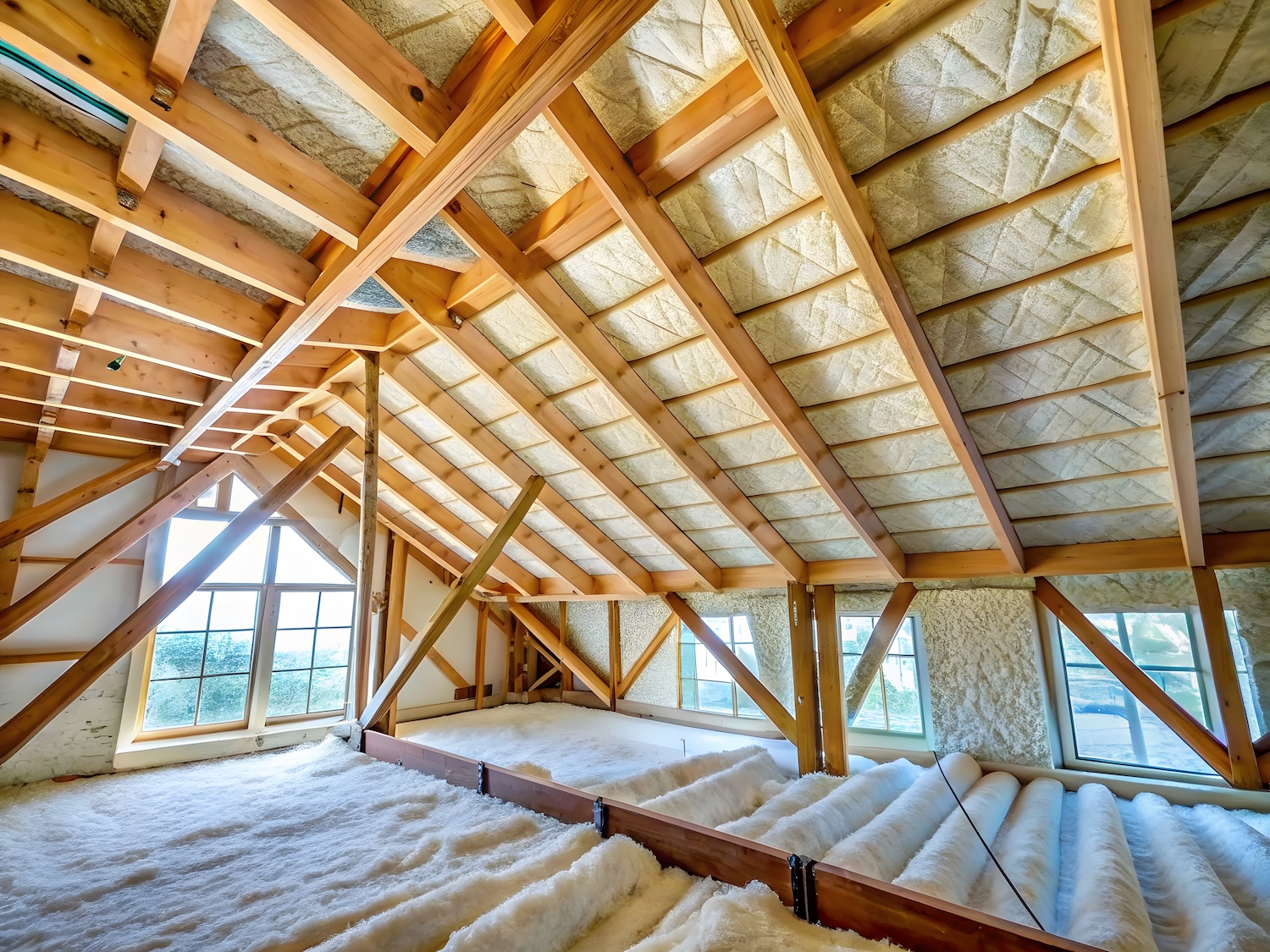
The lighter, softer foam, at about R-3.6 per inch. It suits a home's roof deck and walls, where there's room to build up depth, and it seals gaps as it goes on.
The dense, rigid one. At about R-6 per inch, closed-cell packs more insulation into less space and holds back air and water vapor better. Metal buildings are a natural fit.
We spray foam for homeowners, custom builders and commercial owners. If all you want is more depth on the attic floor, a blown-in top-up may be the simpler fix, and we'll tell you so.
Call us or send the details online. We follow up within one business day.
Call (480) 339-0036 Request a Quote OnlineThe city's industrial side sits along the Bullard Avenue corridor and around Phoenix Goodyear Airport. If you own or are building a metal building in that area, closed-cell foam is worth pricing. Its density suits thin metal walls and roofs.
The city is building fast: about 8% of its homes went up in 2020 or later, in master-planned communities like Estrella and Palm Valley. On a custom home, foam is easiest to plan before the walls close, so bring us in while the plans are still on paper.
Most homes here date from 2000 or later. In a house that age, moving insulation from the attic floor to the roof deck is a bigger project than a top-up. We look at the attic and roof framing first, then tell you whether foam or blown-in fits better.
Commercial projects here go through the City of Goodyear for permits and inspections. With no statewide energy code, the IECC edition the city adopts sets the rules. We size the foam depth to the R-value your plans call for, then plan around inspection dates.
Whoever sprays your attic or building is a Vezina employee. We don't hand spray foam jobs to subcontractors, so one company answers for the work.
Foam isn't always the answer. Our crews also install batts and loose-fill, so we can recommend whichever product suits the space and the budget.
Send plans, and a detailed bid reaches you within 48 hours. Each community also gets its own named project manager.
From our office, Goodyear City Hall is about 10.7 miles away, roughly 16 minutes on I-10 without traffic. A second visit is a short trip for us.
We hold AZ ROC #345515, and we're bonded and insured with liability and workers' comp coverage. We've been in business since 2005.
We work from a single custom home up to a 500-unit community, and we spray metal buildings and commercial spaces too.
It depends on the space. Open-cell is lighter and softer, at about R-3.6 per inch, and it suits roof decks and walls with room for depth. Closed-cell is dense and rigid, at about R-6 per inch, with more resistance to air and water vapor. Whichever you pick, it seals air leaks right where it lands. We'll match the foam to the job after we see it.
Yes. Closed-cell foam is a strong match for metal buildings because it's dense, rigid and resists air and water vapor. At about R-6 per inch, it puts more R-value into thin wall and roof cavities. Commercial projects here are permitted and inspected by the city, and we plan our work around those inspections.
Sometimes. Most homes here went up in 2000 or later, so the attic floor likely has a layer already. If you only want more depth, blown-in is the simpler job. Foam makes more sense when you want the insulation at the roofline, as in an unvented attic. We'll show you both options and what each one involves.
In an unvented attic, the foam goes on the underside of the roof deck instead of on the attic floor. The attic is sealed rather than vented to the outside, so it sits inside the insulated shell of the house. It's a bigger change than a top-up, so we look at the roof framing and the attic first.
Thickness follows the target. Hitting a given R-value takes less closed-cell, at about R-6 per inch, than open-cell, at about R-3.6. New construction is sized to the IECC edition the city enforces. In an existing home, we size it to the goal we set with you at the visit.
Yes. Send plans early, since foam work is simplest before drywall goes up. We return a detailed bid within 48 hours of getting them, and the community gets a named project manager. After closing, builders get warranty service from us as well: one call, and we handle it.
No. Goodyear is APS territory, and SRP's rebates are only for SRP customers. A foam job here won't qualify for SRP's attic program. We'd rather tell you that before the quote than after. We'll price the foam on its own, with no rebate built in.
Yes. We supply and install windows, doors and insulation under one contract, so a custom home can have one crew and one point of contact for all three. Window lines include Milgard, Andersen, LaCantina, Western Window Systems and Win-Dor. See our window and door page for what we install.
Tell us if it's a home, a custom build or a commercial building, and send plans if you have them. We'll reply within one business day.
(480) 339-0036Phoenix office
7310 W Roosevelt St, Ste A12
Phoenix, AZ 85043
Mon-Fri, 7:00 AM to 5:00 PM
Roof deck, custom build or metal shop, we'll tell you which foam fits and why.